Documentation Hub
Welcome to the _codex_ documentation hub. Comprehensive documentation for the ML/AI platform with autonomous agent orchestration.
Last Updated: 2026-06-22
🧠 Cognitive Brain (Start Here for AI Agents)
Unified Navigation System
- 🗺️ Cognitive Map - Complete architecture, components, flows, dependencies
- 📊 Dashboard - Live status, current work, blockers, metrics
- 🎯 Roadmap - Iteration plans, priorities, future scope
Why This Matters
The cognitive brain enables: - Context Continuity: AI agents maintain understanding across sessions - Efficient Navigation: Quick discovery of components, entry points, relationships - Duration-Aware Planning: Maximize work within token/time budgets - Best Path Forward: Always know the next most valuable task - Autonomous Operation: Self-directed agents without constant human guidance
🚀 Quick Links
🚨 CI Rescue & Health
- 🔄 CI Rescue Pipeline — Golden-path documentation: how workflow failures automatically trigger Copilot sessions. Includes Mermaid flowcharts, sequence diagrams, deduplication state machine, anti-pattern map. (S244 — 2026-03-30)
- 📋 CI/CD Index — All CI failure analysis, fix summaries, and validation reports
Core Documentation
- 📖 Architecture - Detailed technical architecture
- 🤝 Contributing - Development workflow and guidelines
- 🔐 Admin Guide - Setup and management
- 📚 API Reference - Complete API documentation
- 📋 Getting Started - Quick start guide
- 📝 Examples - Code examples
- 📜 Changelog - Release history
MCP Package System (93+ KB Documentation)
- 📦 Quick Start - 5-minute onboarding guide
- 📘 Packaging Guide - Complete packaging workflows
- 🎯 Packageable Capabilities - Capability transfer framework
- 🤖 ChatGPT System Prompt - AI assistant prompt template
- 🧭 Navigation System - Universal navigation framework
- 🚀 Advanced Features - Future roadmap
Capability Guides
- 📝 Model Checkpointing - Checkpoint management with SafeTensors
- 🏋️ Training Loops - Production training patterns
- 🔧 PEFT Techniques - Parameter-efficient fine-tuning
- ✅ Code Quality - Complete quality stack
🧭 Orientation Pillars
- Reasoning roadmap — Track milestone health and forward-looking bets in README_ROOT.md.
- Architecture — Pair
diagrams/architecture.svgwith the systems notes inguides/reasoning_overview.md. - Curriculum design — Apply the phased training playbooks from
guides/first_principles_curricula.md. - Bespoke hosting expectations — Align ops and status updates with
deployment/reasoning_pod.mdand the rollout checklists undertemplates/.
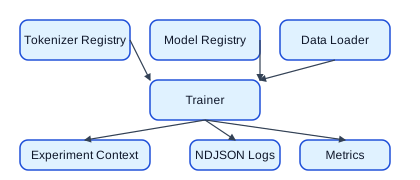
Reasoning Pod Deployment
Refer to deployment/reasoning_pod.md and the configs/deploy/reasoning_pod.yaml for dry-run deployment guidance. These assets are designed for offline validation and do not require hosted services.
🚀 Quick Links for Reasoning Teams
- Reasoning templates in the CLI —
codex reasoning-templates listsurfaces curated training/eval bundles. See thecodex_clihelp for command details. - End-to-end quickstart — Follow
quickstart.mdwith the+reasoning=baselineoverrides highlighted inREADME_ROOT.md. - Evaluation ledger — Use
guides/reasoning_overview.mdto configure NDJSON metrics pipelines. - Deployment guardrails — Cross-check bespoke model expectations against
guides/serving_reproducibility.md.
📋 Operational Templates
Operational templates encode recurring delivery rituals so teams can execute migrations, hardening passes, and planning checkpoints with consistent safeguards. Begin with the Operational Templates index to review prerequisites, required metadata, and cross-references before copying a template into your service.
When to Use a Template
- You are planning a migration or hardening effort that will cross team boundaries.
- You need an auditable checklist with rollback, communications, and verification steps.
- You want a consistent structure for maintaining ≥85% coverage through scoped test additions.
Quick Links
Handoff Checklist
Each template includes role guidance (developers draft → maintainers execute), [PLACEHOLDER: …] prompts, and success criteria aligned with the coverage standard. Ensure the following before requesting review:
- All placeholders are replaced with repo-specific context and linked artifacts.
- Rollback and communication steps point to real runbooks or dashboards.
- The template is stored alongside the service codebase (usually under
docs/) and linked from the change description or PR.
See CONTRIBUTING for the full drafting workflow and role expectations.
📊 Phase 8.7: Universal Intelligence
Complete meta-learning framework with 170 tests.
Components: - Universal Task Interface - Meta-Policy Router (MAML/Reptile) - Abstraction Engine - Grounding Layer - Pattern Store - Safety Monitor - EXP-10 Validation
Quick Example
from github.agents.core.universal_intelligence import UniversalTaskInterface, TaskSpec

spec = TaskSpec(
    environment="gridworld",
    initial_state={"x": 0, "y": 0, "goal": {"x": 5, "y": 5}},
    reward_spec={"id": "reward:v1"},
    termination={"max_steps": 100},
)

uti = UniversalTaskInterface(seed=12345)
result = uti.execute_task(spec)
⚙️ Installation
🚢 Deployment and Operational Expectations
To generate and review a deployment manifest for a bespoke reasoning agent, run a dry-run deploy:
codex deploy \
  --config configs/deploy/reasoning_pod.yaml \
  --model artifacts/runs/reasoning-starter:last \
  --dry-run
This renders the "reasoning pod" manifest for inspection. It does not create or update any live service. See deployment/reasoning_pod.md for what that pod is expected to look like (resources, telemetry, trace capture mode, curriculum phase, etc.).
Rollout Rings
This repository uses staged rollout rings to represent maturity and review state:
0A_base_/0B_base_: active development, unstable knobs.0C_base_: integration of multiple features landing together.0D_base_: release candidate. Content here should be explainable to Engineering and Product.main: canonical internal "alpha product" surface after approval.
📏 Conventions
- Keep docs small and composable.
- Use a single fenced
diffblock for proposed patches in prompts/guides. - Prefer citations to live repo files when referencing code or config.
📚 Related
- Project audit ritual: see
AUDIT_PROMPT.md - CHANGELOG practices follow "Keep a Changelog" with an Unreleased section at the top.
Last updated: 2026-06-22